
The Yoga is Now studio is a haven of serenity, where every breath connects body and mind, bringing balance, well-being and lightness to the present. Yoga teacher Christelle's studio was the perfect choice for a photo shooting of Deborah Rocha's handmade silk scarves made from elements of nature.
Era uma manhã de quarta-feira, 7 de agosto de 2024, quando nos encontramos, primeiro para uma sessão relaxante de yoga no estúdio Yoga is Now. Com as lentes da fotógrafa Juliana Bezerra de Mello, capturamos belíssimas imagens minimalistas dos lenços – as grandes estrelas do dia. A iluminação suave e a luz natural, que entrava pelas amplas janelas de vidro do espaço, criaram composições em uma atmosfera aconchegante, onde todos participaram cheios de ideias e entusiasmo.

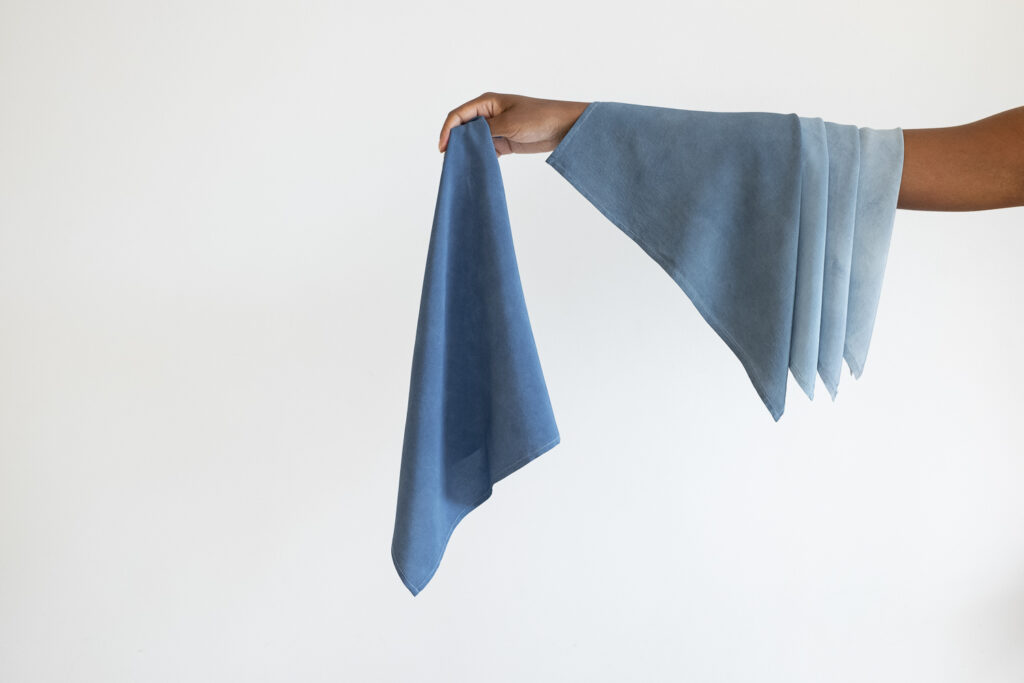


In the afternoon, we explored the foulard-dyeing laboratory, located in Deborah's home, where we photographed the preparation of the colors and their natural dye sources.
A cor azul foi um dos elementos de inspiração para a criação da marca Do Fio da Seda, plataforma multidisciplinar na qual Deborah Rocha explora e desenvolve lenços de seda tingidos artesanalmente com elementos naturais, como o índigo, que dá vida aos lenços em tons de azul.
Em sua palestra “Ode ao Azul”In her talk entitled “Ode to Blue”, Deborah shares her experiences and knowledge of the history and magic of this silky color at the crossroads of the Silk Road and the Spice Road. A sustainable and transformable journey towards Brazilian blue. The Do Fio da Seda project is dedicated to tracing the paths of silk threads, its history, and uses in various knowledge achievements. It seeks to associate silk weaves and its art with complex human relationships.

A palavra índigo tem origem no latim indicum, que significa “da Índia“, fazendo referência ao local de onde os europeus importavam o pigmento. Esse termo, por sua vez, vem do grego indikon, com o mesmo significado. O índigo é um dos corantes naturais mais antigos da humanidade, extraído tradicionalmente da planta Indigofera tinctoriaThe word indigo comes from the Latin indicum, meaning “from India”, in reference to the place where Europeans imported the pigment. This term in turn comes from the Greek indikon, which has the same meaning. Indigo is one of mankind's oldest natural dyes. It is traditionally extracted from the Indigofera tinctoria plant, cultivated in India, China, Africa and South America. It was widely used by ancient civilizations such as the Egyptians, Persians, Greeks and Romans to dye fabrics. Over time, the word indigo came to designate both the color and the pigment, becoming an emblematic hue associated with depth, spirituality and traditional craftsmanship. índigo passou a designar tanto a cor quanto o pigmento, tornando-se um tom icônico, associado à profundidade, espiritualidade e tradição artesanal.

“Tingidos à mão por Deborah, esse processo de coloração com elementos naturais chamou imediatamente minha atenção”, diz Juliana Bezerra. “Como fotógrafa, também sigo um processo artesanal na criação de imagens com uma técnica histórica da fotografia: o cianótipo, que também permite ‘colorir’ a imagem por meio de banhos em diferentes produtos naturais”, continua.
“I found many similarities between Deborah’s artisanal practice of dyeing and cyanotyping: there's a real involvement in his activity, because everything is done by hand, with great care, respecting time and materials. There's also an alchemical dimension... Daring to experiment, seeking in experimentation and even in imperfections a way to keep the history of the material alive, while creating new narratives”.
 Portuguese
 French
 English
 Italian